
About David Goggins
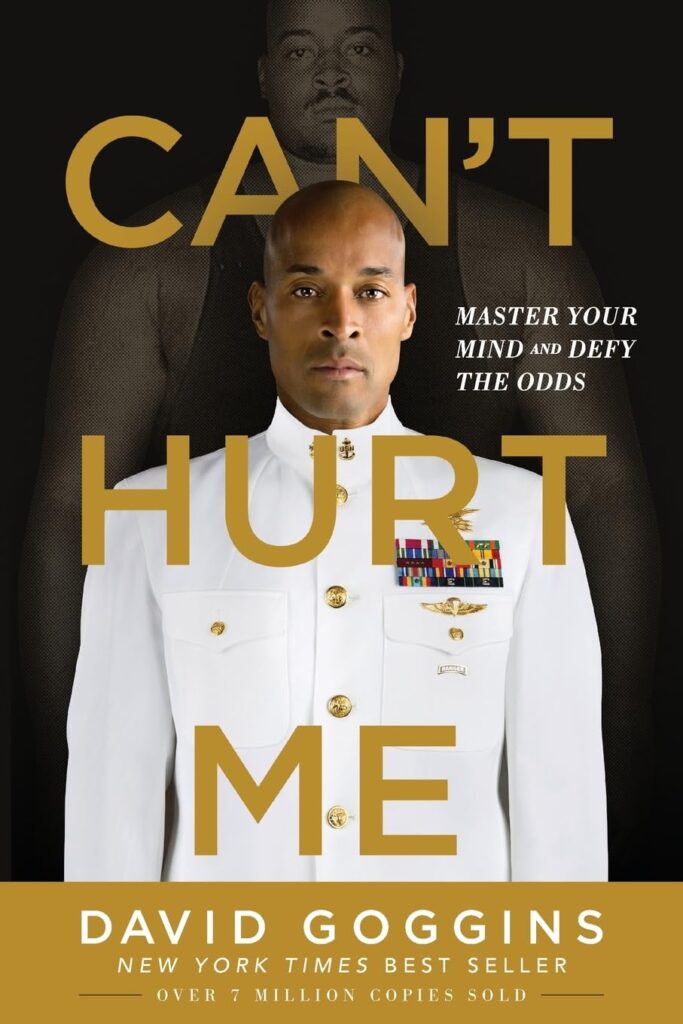
David Goggins is a retired Navy SEAL and one of the most extreme endurance athletes in the world. He has completed over sixty ultra-marathons, triathlons, and ultra-triathlons—often setting new course records and regularly finishing in the top five. He once held the Guinness World Record for completing 4,030 pull-ups in seventeen hours. Remarkably, he is the only person in history to complete elite training as a Navy SEAL, Army Ranger, and Air Force Tactical Air Controller. His extraordinary feats of endurance and mental toughness earned him the title of “The Fittest (Real) Man in America” from Outside magazine—and he continues to inspire millions worldwide to push past their limits.
About The Book
“Heraclitus, a philosopher born in the Persian Empire back in the fifth century BC had it right when he wrote about men on the battlefield. ‘Out of every hundred men,’ he wrote, ‘ten shouldn’t even be there, eighty are just targets, nine are the real fighters, and we are lucky to have them, for they make the battle. Ah, but the one, one is a warrior…’
From the time you take your first breath, you become eligible to die. You also become eligible to find your greatness and become the One Warrior. But it is up to you to equip yourself for the battle ahead. Only you can master your mind, which is what it takes to live a bold life filled with accomplishments most people consider beyond their capability.
I am not a genius like those professors at MIT, but I am that One Warrior. And the story you are about to read, the story of my fucked-up life, will illuminate a proven path to self-mastery and empower you to face reality, hold yourself accountable, push past pain, learn to love what you fear, relish failure, live to your fullest potential, and find out who you really are.
Human beings change through study, habit, and stories.”
Goggins is a former Navy SEAL, a world-record holder (4,030 pull-ups in seventeen hours!), and an ultra-endurance athlete with over sixty races behind him. People call him the fittest man in America, and with 14 million Instagram followers, his message resonates: you can do hard things… and doing hard things changes you.
Can’t Hurt Me kept crossing my path until I finally made it my running companion. And honestly? It nudged me out the door more often.
This autobiographical book is Goggins’ story of transformation – how he went from a 297-pound exterminator, weighed down by childhood trauma and statistics, to someone who chose to create a different identity through relentless effort and deep inner work. His life is a reminder that our starting point doesn’t define us. Our patterns aren’t our destiny. We get to participate in the story we tell about ourselves.
If you’re feeling stuck in a victim mindset, or if you’re craving a shift into a “creator” mindset – the sense that I can do hard things, and OWN my life – this book offers both the challenge and the invitation.
And one of my favourite parts? The practical challenges at the end of each chapter. They’re grounding, clarifying, and surprisingly doable. They help you translate inspiration into action – not from a place of self-criticism, but from a place of self-belief.
Here are the ideas that stayed with me the most. Let’s dive in.
Key Insights
Adults Who Care Matters
“Annunciation was a small school. Sister Katherine taught all of first and second grade in a single classroom, and with only eighteen kids to teach, she wasn’t willing to shirk her responsibility and blame my academic struggles, or anybody’s bad behavior, on learning disabilities or emotional problems. She didn’t know my backstory and didn’t have to. All that mattered to her was that I turned up at her door with a kindergarten education, and it was her job to shape my mind. She had every excuse in the world to farm me out to some specialist or label me a problem, but that wasn’t her style. She started teaching before labeling kids was a normal thing to do, and she embodied the no-excuses mentality that I needed if I was going to catch up.
Sister Katherine is the reason why I’ll never trust a smile or judge a scowl. My dad smiled all the time and didn’t care about me, but grouchy Sister Katherine cared about us, cared about me. She wanted us to be our very best. I know this because she proved it by spending extra time with me, as much time as it took, until I retained my lessons. Before the year was out, I could read at a second grade level.”
Goggins opens the book by taking us straight into his childhood – an abusive father (not mildly abusive, but terrifyingly so), gruelling work in the family business, relentless toxic stress, racism, neglect, and even witnessing death. Reading that first chapter gave me shivers. It’s the kind of childhood that, statistically, should break a child long before adulthood arrives.
And yet – there were two anchors in his life: a mother who fought for him when she could, and at some point Sister Katherine, whose story is such a powerful reminder of something we often forget as parents and caring adults. It takes just one person – one steady, invested, emotionally present adult – to shift a child’s trajectory.
What Sister Katherine modelled is the essence of what psychologists call the Mentor Mindset (aka authoritative parenting or wise parenting):
High expectations + deep, consistent support.
Not sugarcoating. Not rescuing. Not labelling. Just grounded belief paired with steady guidance.
Paul Tough writes in How Children Succeed about how toxic stress can alter a child’s life path and how the presence of even one caring, reliable adult dramatically changes the outcome. Goggins is one of those living examples.
And in The Life Project, Helen Pearson echoes this: among children “born to fail,” the ones who beat the odds all had at least one adult – usually a parent, sometimes a teacher – who believed in them fiercely and showed up consistently.
For Goggins, that person was Sister Katherine.
For our kids, we get to choose to be that person.
The Accountability Mirror
“You are giving up instead of getting hard! Tell the truth about the real reasons for your limitations and you will turn that negativity, which is real, into jet fuel. Those odds stacked against you will become a damn runway.
There is no more time to waste. Hours and days evaporate like creeks in the desert. That’s why it’s okay to be cruel to yourself as long as you realize you’re doing it to become better. We all need thicker skin to improve in life. Being soft when you look in the mirror isn’t going to inspire the wholesale changes we need to shift our present and open up our future.”
That’s from the chapter “Truth Hurts.” And this is where Goggins introduces one of his most famous tools: the Accountability Mirror.
The idea is simple, but not easy: You can’t change what you refuse to see. To take the first step, you need to spark urgency and set your butt on fire. And that starts with facing the truth of your current reality without fluff, without excuses, without softening the edges. Then you own it.
This reminded me immediately of Carol Dweck’s wisdom in Mindset, where she writes about the importance of the honest constructive feedback for kids:
“Withholding constructive criticism does not help children’s confidence; it harms their future.”
Her point? Honesty is an act of care. We grow when we see where we are and what needs work – whether we’re adults chasing goals or children learning how to learn.
And it connects beautifully with Jordan Peterson’s rule “Tell the truth, or at least don’t lie” in his great book 12 Rules For Life. Peterson argues that lies – especially the ones we tell ourselves – distort reality. They keep us stuck in a version of life that feels safer but ultimately creates suffering. Growth starts with the courage to see what is.
So how do we take all this from theory to action? Goggins is clear:
“I tacked Post-It notes on my Accountability Mirror, and I’ll ask you to do the same. Digital devices won’t work. Write all your insecurities, dreams, and goals on Post-Its and tag up your mirror. If you need more education, remind yourself that you need to start working your butt off because you aren’t smart enough! Period, point blank. If you look in the mirror and see someone who is obviously overweight, that means you’re fat! Own it! It’s okay to be unkind with yourself in these moments because we need thicker skin to improve in life. Whether it’s a career goal (quit my job, start a business), a lifestyle goal (lose weight, get more active), or an athletic one (run my first 5K, 10K, or marathon), you need to be truthful with yourself about where you are and the necessary steps it will take to achieve those goals, day by day.”
Now, here’s where I add the layer I wish every reader would consider: Pair honesty with neutrality.
You don’t have to beat yourself up to tell the truth. You can say: “This is where I am. This is where I want to be. What’s one next step?”
That’s Trevor Moawads Neutral Thinking (check out our notes on It Takes What It Takes) – removing drama from your self-talk and focusing on action.
Honesty + neutrality = clarity + momentum.
And once you have clarity and momentum… you’re already on your way.
The Cookie Jar
“I remembered as a kid, no matter how difficult our life was, my mother always figured out a way to stock our cookie jar. She’d buy wafers and Oreos, Pepperidge Farm Milanos and Chips Ahoy!, and whenever she showed up with a new batch of cookies, she dumped them into one jar. With her permission we’d get to pick one or two out at a time. It was like a mini treasure hunt. I remember the joy of dropping my fist into that jar, wondering what I’d find, and before I crammed the cookie in my mouth I always took the time to admire it first, especially when we were broke in Brazil. I’d turn it around in my hand and say my own little prayer of thanks. The feeling of being that kid, locked in a moment of gratitude for a simple gift like a cookie, came back to me. I felt it viscerally, and I used that concept to stuff a new kind of Cookie Jar. Inside it were all my past victories.”
This story from Goggins’ childhood is unexpectedly tender – softness in a life that was anything but. And years later, in the middle of attempting his Guinness World Record for pull-ups (after failing twice) or pushing through yet another brutal ultra-endurance race, when his body was screaming and quitting seemed like the only possible option, he reached for that memory.
Not the literal cookies. The Cookie Jar in his mind. A mental archive of every triumph, every hard thing he survived, every moment he proved to himself that he was capable of more than he believed.
This is the psychological genius of the concept: When you’re in pain, you don’t rise to your potential – you fall back on your training. And the Cookie Jar is your training. It’s the emotional shorthand for: I’ve done hard things before. I can do them again.
As he explains:
“That’s one reason I invented the Cookie Jar. We must create a system that constantly reminds us who […] we are when we are at our best, because life is not going to pick us up when we fall. There will be forks in the road, knives in your […] back, mountains to climb, and we are only capable of living up to the image we create for ourselves.”
For parents, this idea is gold. It reminds us that one of the greatest gifts we can give our kids is not shielding them from hard things but helping them notice their victories, internalise them, and store them – so when life gets painful, they have somewhere to reach.
And for us?
Well, adults need Cookie Jars too.
The Calloused Mind
“[…] leaning on your calloused mind in the heat of battle can shift your thinking as well. Remembering what you’ve been through and how that has strengthened your mindset can lift you out of a negative brain loop and help you bypass those weak, one-second impulses to give in so you can power through obstacles. And when you leverage a calloused mind like I did around the pool that day and keep fighting through pain, it can help you push your limits because if you accept the pain as a natural process and refuse to give in and give up, you will engage the sympathetic nervous system which shifts your hormonal flow.”
The calloused mind is one of Goggins’ most powerful ideas. Just like hands toughen with repeated friction, the mind toughens through repeated exposure to discomfort, challenge, and doing the hard things we’d rather avoid. In other words: this is what real resilience is made of.
And it starts with one simple – but uncomfortable – choice: Step outside your comfort zone on purpose, and often.
Goggins is very clear about this:
“The first step on the journey toward a calloused mind is stepping outside your comfort zone on a regular basis. Dig out your journal again and write down all the things you don’t like to do or that make you uncomfortable. Especially those things you know are good for you.”
Every small act of discomfort becomes a mental rep. Over time, these reps build a stronger internal voice -one that says I can handle this instead of I can’t.
“Doing things—even small things—that make you uncomfortable will help make you strong.”
And the more often you do them, the more your mind learns to stay steady in stressful moments.
This also echoes Phil Stutz and Barry Michels in The Tools:
“Life provides endless possibilities, but along with them comes pain. If you can’t tolerate pain, you can’t be fully alive.”
So here’s your reflection moment: What is one hard thing you’ve been avoiding for far too long? Start there. Make it small. Make it doable. Then step toward it – one rep outside your comfort zone at a time.
40% Rule
“Sadly, most of us give up when we’ve only given around 40 percent of our maximum effort. Even when we feel like we’ve reached our absolute limit, we still have 60 percent more to give! That’s the governor in action! Once you know that to be true, it’s simply a matter of stretching your pain tolerance, letting go of your identity and all your self-limiting stories, so you can get to 60 percent, then 80 percent and beyond without giving up. I call this The 40% Rule, and the reason it’s so powerful is that if you follow it, you will unlock your mind to new levels of performance and excellence in sports and in life, and your rewards will run far deeper than mere material success.”
I love this idea. It applies to everything: work, parenting, relationships, even how we approach our own growth. When you start from the thought that you still have 60% more to give, giving up when you’re not even halfway in suddenly feels ridiculous. It changes the way you show up, the energy you bring, and your willingness to stretch yourself further.
Knowing you can push beyond the point of discomfort transforms not just what you do, but who you are in that moment.
P.S. Want more ideas on unlocking your potential – or your kids’? Check out our notes on Limitless by Jim Kwik and Hidden Potential by Adam Grant.
Action Steps For You
- Use the Accountability Mirror. Write your insecurities, goals, and daily challenges on Post-It notes and stick them on a mirror. Look at yourself honestly each day, own where you are, and identify the next small step to move forward.
- Step Outside Your Comfort Zone Daily. Make a list of the things you avoid because they’re uncomfortable – even small ones. Pick one each day to tackle. Repetition will build your calloused mind and strengthen resilience.
- Build Your Mental Cookie Jar. Keep a record of all your past wins, moments of perseverance, and achievements. Whenever you feel like giving up, reach into your “Cookie Jar” and remind yourself of your strength and capability.
Quotes From The Book
“A lot of people think that once they reach a certain level of status, respect, or success, that they’ve made it in life. I’m here to tell you that you always have to find more. Greatness is not something that if you meet it once it stays with you forever. It evaporates like a flash of oil in a hot pan.”
“In life, there is no gift as overlooked or inevitable as failure. I’ve had quite a few and have learned to relish them, because if you do the forensics you’ll find clues about where to make adjustments and how to eventually accomplish your task.”
“Luck is capricious. It won’t always go your way, so you can’t get trapped in this idea that just because you’ve imagined a possibility for yourself that you somehow deserve it. Your entitled mind is dead weight. Cut it loose. Don’t focus on what you think you deserve. Take aim on what you are willing to earn!”
“The most important conversations you’ll ever have are the ones you’ll have with yourself. You wake up with them, you walk around with them, you go to bed with them, and eventually you act on them.”
“Remember, visualization will never compensate for the work undone. You cannot visualize lies. All the strategies I employ to answer the simple questions and win the mind game are effective because I put in work. It’s a lot more than mind over matter. It takes relentless self-discipline to schedule suffering into your day, every day, but if you do, you’ll find that at the other end of that suffering is a whole other life just waiting for you.”
“The reason it’s important to push hardest when you want to quit is because it helps callous your mind. It’s the same reason why you have to do your best work when you are least motivated.”