

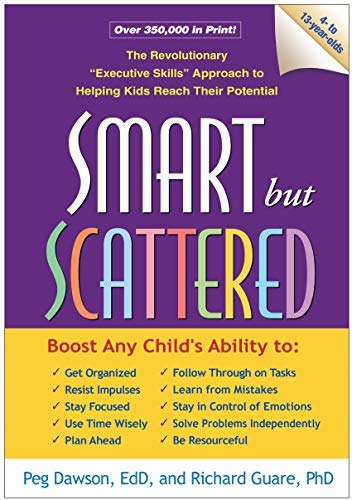
About Peg Dawson and Richard Guare
Peg Dawson, EdD, is a staff psychologist at the Center for Learning and Attention Disorders at Seacoast Mental Health Center in Portsmouth, New Hampshire, where she specializes in the assessment of children and adults with learning and attention disorders. Dr. Dawson is a past president of the New Hampshire Association of School Psychologists, the National Association of School Psychologists, and the International School Psychology Association. She is a recipient of the National Association of School Psychologists’ Lifetime Achievement Award.
Richard Guare, Ph.D., BCBA-D is a Clinical Psychologist with a specialization in Neuropsychology and a board-certified behaviour analyst. For 25 years he was the director of the Center for Learning and Attention Disorders at Seacoast Mental Health Center in Portsmouth, NH where he worked with families and schools on intervention strategies. Dick received his doctorate in Clinical/School Psychology from the University of Virginia and completed a postdoctoral fellowship in Neuropsychology at Children’s Hospital Boston and the Boston VA Medical Center. His interests are in the areas of attention, learning and behavior challenges and the development of executive skills.
About The Book
“You know your son or daughter has the brains and the heart to succeed. Yet teachers, your friends, maybe your own parents, and that nagging little voice in your head all say the child isn’t where he or she should be. You’ve tried everything— pleading, yelling, cajoling, bribing, explaining, maybe even threatening or punishing your child to get him to buckle down and do what’s expected of him or muster up the self-control to act his age. Nothing has worked.
That’s because what your child may lack is skills. You can’t talk children into using skills they don’t have any more than the right incentive could get you safely down a black diamond run when you can’t even ski the bunny hill. Your child may very well want and have the potential to do what’s required but just doesn’t know how. Scientists who study child development and the brain have discovered that most children who are smart but scattered simply lack certain habits of mind called executive skills. These are the fundamental brain-based skills required to execute tasks: getting organized, planning, initiating work, staying on task, controlling impulses, regulating emotions, being adaptable and resilient-just about everything a child needs to negotiate the typical demands of childhood in school, at home, and with friends. Some kids lack certain executive skills or lag behind in developing them.”
I first picked up Smart but Scattered after finishing Ross Greene’s The Explosive Child, where he shares an insight that forever changed how I see kids: children do well when they can. Not when they “want to,” not when you bribe them with ice cream, and definitely not when you threaten to take away Wi-Fi.
Which means that behind the tantrums, the unfinished homework, the “I’ll do it later” chorus, there’s usually not a willpower problem – it’s a skills problem. Executive skills, to be exact. And here’s the genius of Dawson and Guare: instead of leaving parents stuck in the “nag-yell-regret” cycle, they hand us a map to actually build those missing skills and help kids reach their full potential. Suddenly it’s not parent vs. child anymore, it’s parent & child vs. the problem.
Backed by neuroscience and psychology, the book breaks down what executive skills really are and shows us how to spot which ones are strong and which ones need work. It’s practical, systematic, and loaded with case studies that will make you say, “Wow, that’s my child.” From homework battles to time management issues, it gives you play-by-play strategies for the daily dramas every parent knows too well.
In these notes, I’ll distill the core ideas for you – but trust me, you’ll want your own copy for the questionnaires and step-by-step guides.
Let’s dive in.
Key Insights
11 Executive Skills
“When people hear the term executive skills, they assume it refers to the set of skills required of good business executives-skills like financial management, communication, strategic planning, and decision making. There is some overlap executive skills definitely include decision making, planning, and management of all kinds of data, and like the skills used by a business executive, executive skills help kids get done what needs to get done-but in fact the term executive skills comes from the neurosciences literature and refers to the brain-based skills that are required for humans to execute, or perform, tasks.”
Here’s the big idea: executive skills aren’t just for CEOs. We all need them. Because “executing tasks” is literally what life is. And kids need these skills from the early age.
Whether it’s something simple like pouring a glass of milk and remembering to put the carton back in the fridge this time, or something bigger like getting ready for school on time without leaving behind one shoe, a lunchbox, or their sanity, it all comes down to executive skills. And as children grow, the demands get more complex: time management, self-control, planning ahead, even reflecting on their own thinking (aka metacognition).
Dawson & Guare outline 11 executive skills:
- Response inhibition
- Working memory
- Emotional control
- Sustained attention
- Task initiation
- Planning/prioritization
- Organization
- Time management
- Goal-directed persistence
- Flexibility
- Metacognition
If this list sounds familiar, it’s because it overlaps with Ellen Galinsky’s essential life skills (Mind in the Making) and Madeline Levine’s coping skills (Teach Your Children Well). The point? These are the skills kids need to thrive in life.
The book includes a handy questionnaire to help you pinpoint your child’s (and yes, your own) executive skills strengths and weaknesses. Even better, it sets realistic expectations for what skills kids can actually handle at different ages. Translation: you can stop wasting energy trying to teach your 5-year-old to manage their own Google Calendar or meal prep for the week.
The good news is that childhood and adolescence are prime time for building executive skills. The brain is literally under construction – growing, pruning, rewiring – which makes it the best playground for installing habits that stick. Far better to strengthen these skills early than spend your 30s rereading Atomic Habits trying to fix what never got built in the first place.
If you’re curious, the authors even have an online questionnaire (link here) so you can test whether your child’s behaviours driving you nuts are actually just gaps in executive skills. For me, it was an “aha!” moment: one child clearly struggles with flexibility, another with task initiation, and all of them‚ let’s just say “response inhibition” and “emotional control” are works in progress.
Once you spot the gaps, you can create a plan to strengthen them. But here’s the twist: it’s way easier to teach the skills we are naturally good at as parents.
Which brings us to the next insight.
Parents’ Executive Skills And The “Goodness Of Fit”
“If your son’s or daughter’s executive skill weaknesses drive you crazy, there’s a good chance that it’s because you’re strong in those executive skills. […]
When parents have one set of executive skill strengths and weaknesses and their children have another set, they’re missing out on what we call “goodness of fit.” Not only is the potential for conflict between parent and child over daily routines increased, but the stage isn’t set for helping the child build the deficient skills.
[…] there are various ways that you can help a child compensate for and even eliminate weaknesses in executive skills. They all, to some degree, involve interacting differently with your child. Until you understand how your executive skill strengths and weaknesses dovetail— or don’t—with your child’s, it will be tough to know where to change your act. When you have a clearer understanding, about the nature of executive skills in general and about your own processing style specifically, you’ll find it easier to understand your child and to identify intervention strategies that are a good match for your child’s strengths.”
In other words, your own executive skills matter a lot. And chances are, you inherited many of them from your parents (the good, the bad, and the procrastination). When it comes to your child, the way your strengths and weaknesses line up with theirs can make everyday life either a battlefield or a classroom.
Here are the four possible scenarios:
- Your child’s weakness = your strength
This one creates the most clashes, but it’s also the easiest place to teach. You know this skill, you use it daily, and you can model it. My older son, for example, struggles with flexibility when plans change. Me? Flexibility is one of my superpowers (and luckily patience too, because this one takes practice). It’s frustrating in the moment, but it’s a good fit because I can guide him.
- Your child’s strength = your strength
Celebrate this! High-fives all around. Just keep nurturing it and give your child more opportunities to use that skill.
- Your child’s weakness = your weakness
Ah yes, the tension zone. This is where you’ll both get triggered – but also where you can grow together. Think emotional regulation. (Google search traffic tells us it’s the top parenting struggle: ever typed in “how to be a calm parent” at 11 p.m. after a meltdown? Exactly.) If you want your child to regulate emotions, you’ll have to master it first. Painful, yes. Powerful, absolutely.
- Your child’s strength = your weakness
This is humbling‚ and kind of brilliant. Here, your child becomes the teacher. Ask them how they do it. Kids love being the “expert,” and you might just learn a few tricks for free.
And here’s the kicker: even when you’ve got your own executive skills fairly sorted, stress is like kryptonite. It drains them fast. Which means that no matter how good you usually are at planning, prioritising, or keeping calm, once stress piles up you’ll slip. That’s why mastering a few stress-management techniques is essential. The calmer you stay, the stronger your child’s learning environment will be.
Matching The Child To The Task
“…when there’s a poor fit between the task or the environment and the child’s executive skill profile, children will try to take control of the situation, either by escaping or avoiding it.”
The classic example? Cleaning a room.
If you’ve ever asked a child to “go clean your room,” you already know how this story goes. You walk back 20 minutes later, and the room looks exactly the same – except maybe now the Lego pile has migrated to a new corner. For years this drove me absolutely crazy, until one day I finally asked my son, “Why didn’t you clean your room?” His answer? “It’s so messy, I don’t know where to start.”
And it hit me like a sack of potatoes.
That’s when I pulled out the old saying: “Do you know how to eat an elephant? One bite at a time.” We broke the overwhelming monster-task into tiny, doable chunks:
- Pick up the books
- Put clothes in the wardrobe
- Tidy the desk
- Gather the Lego
And just like that, the impossible became possible.
The same principle works for other everyday battles – like homework. “Do your homework” is way too vague and overwhelming. But “do questions 1–3 in math,” then “write the first sentence of your story,” feels manageable. Once momentum kicks in, the rest often follows.
Here’s the point: when a task feels overwhelming, kids don’t lack the will to do it, they lack the structure. Break it down, make it concrete, and suddenly their executive skills can rise to the challenge. And let’s be honest – adults aren’t much different. Taxes, housework, even writing a book summary all feel easier once you chunk them down into smaller steps.
It reminded me of James Clear’s philosophy of tiny habits in his amazing book Atomic Habits. It works. Really works.
10 Principles For Improving Your Child’s Executive Skills
In the book, the authors outline 10 core principles that will help you teach your child executive skills effectively and design interventions that actually work. Here’s the quick look:
- Teach deficient skills rather than expecting the child to acquire them through observation or osmosis.
- Consider your child’s developmental level.
- Move from the external to the internal.
- Remember that the external includes changes you can make in the environment, the task, or the way you interact with your child.
- Use rather than fight the child’s innate drive for mastery and control.
- Modify tasks to match your child’s capacity to exert effort.
- Use incentives to augment instruction.
- Provide just enough support for the child to be successful.
- Keep supports and supervision in place until the child achieves mastery or success.
- When you do stop the supports, supervision, and incentives, fade them gradually, never abruptly.
On top of this, the authors offer 20 ready-made plans for the routines kids most often struggle with – things like homework, chores, putting belongings away, and following the daily routines. If you’re looking for step-by-step solutions you can plug right in, the book is worth checking out just for that toolkit.
Now, let’s look at the bigger picture: the behavioural change model that helps you design your own interventions.
ABC Model of Behavioural Change
“Behavior management experts often call this the ABC model. A in this model stands for antecedent, B for behavior, and C for consequences. The idea is that there are three opportunities to take measures to elicit or change the behavior as desired: by changing what comes before it (the external factors, or environment), by aiming directly at the behavior itself (through teaching), and by imposing consequences (incentives or penalties).”
When it comes to executive skills, Dawson & Guare use the classic ABC model to design interventions. Here are the parts I find most useful:
- Modifying the environment is often the most powerful lever. It doesn’t require the child to change overnight, but instead sets them up to internalize better habits over time. For example, if your child struggles with attention while doing homework, don’t expect them to resist the pull of TikTok with their phone buzzing next to them. (That’s a battle even most adults lose – read our notes on Adam Alter’s Irresistible, Cal Newport’s Deep Work and Jonathan Haidt’s The Anxious Generation.) Instead, strip away distractions, use visual or verbal cues (like a morning checklist), and shape the social environment – how you and other adults interact before, during, and after a challenging task. (For more on that, Paul Dix’s When The Parents Change, Everything Changes is a gem.)
- Teaching the skills directly. This can be informal – through play, games, personal example and everyday “verbal scaffolding” – or more structured, like setting specific behavioural goals with your child and giving them tools to achieve those goals.
- Positive reinforcement. The best motivator for kids to practice executive skills is praise and encouragement. The authors also suggest formal reward systems like points or tokens, though I personally find those a bit too transactional. What really sticks is when kids feel proud of themselves and recognized by you.
At its core, the ABC model is a great framework for working smarter, not harder: adjusting what comes before, supporting the skill as it happens, and shaping what follows to strengthen the habit.
Make Your Child an Active Participant
“When goals fall into this category, we find it helpful to involve children in the goal-setting process rather than dictating to them what we expect them to do. You’ve probably noticed that this idea falls right in line with the ideas we offered in the scaffolding discussion earlier in this chapter: anything that encourages participation and independent, critical thinking fosters executive skills.”
And here’s where so many parents stumble: we tell kids what to do. All day. Every day. The result? Kids feel bossed around, resentful, and the power struggles kick in.
But there’s a better way. When we stop playing “the boss” and start acting more like a consultant (see Johnson & Stixrud’s The Thriving Child for more on this), the dynamic shifts. Instead of issuing commands, we invite our kids into problem-solving and goal-setting. Suddenly, they’re not passive rule-followers – they’re active participants.
I’ve used this approach with my own kids, and the difference has been tremendous. Less arguing, more cooperation, and most importantly – kids who actually practice the very executive skills we’re trying to teach them.
Action Steps For You
- Map your strengths and weaknesses. Using the questionnaire, take stock of your child’s top three executive skill strengths and weaknesses – and then do the same for yourself. The overlap (or mismatch) explains a lot about daily clashes. Awareness helps you swap judgment for empathy and shows you where you can teach skills most effectively.
- Pick one battle, not all. Choose one recurring challenge – like homework, mornings, or chores – and apply the ABC model and the 10 principles to create a plan.
- Rehearse skills in real life. Don’t wait for big meltdowns to teach self-regulation or problem-solving – practice during low-stakes moments. For example, when a sibling grabs a toy, walk your child through breathing, using words, or negotiating. Rehearsal turns abstract skills into muscle memory.
Quotes From The Book
“When your weakest executive skills seem to suffer a setback, this is a good clue that your stress level is rising. Knowing this about yourself, you may be able to put systems in place to reduce the stress or to cope with your decline in executive functioning.”
“Clearly childhood offers parents and teachers a critical opportunity to enhance the learning and development of executive skills in a child.”
“Parents and other adults who work with children tend to make two kinds of mistakes. They either provide too much support, which means the child is successful but fails to develop the ability to perform the task independently, or they provide too little support, so the child fails and, again, never develops the ability to perform the task independently.”
“In all our years of professional practice, we have met very few children we would call lazy. We’ve met children who are discouraged, who doubt their abilities, who feel it is more punishing to try and fail than not try at all, or who prefer to spend time doing things they find fun rather than things they find tedious or difficult. The critical issue is not whether children can’t or won’t, but what it would take to help them overcome whatever obstacle is preventing them from acquiring proficiency at tasks or completing tasks that are currently not getting done.”
“Whenever possible, practice, role-play, or rehearse the procedure before putting it in place. This will be particularly important if the target executive skill is response inhibition or emotional control. Because things can happen quickly in real life and because the problem behavior often occurs in emotionally charged situations, the more practice the child can get when her emotions are not at their peak, the more likely she’ll be able to follow the script in the heat of the moment.”