
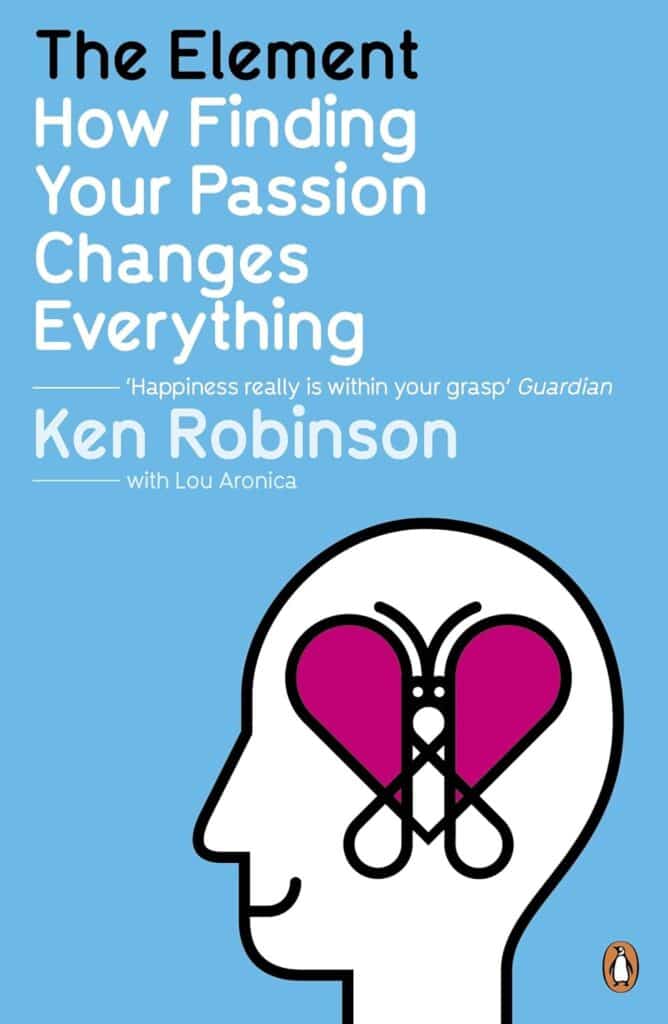
About Sir Ken Robinson and Lou Aronica
Sir Ken Robinson, PhD, was an internationally recognised leader in the development of creativity, innovation and human potential. He advised governments, corporations, education systems, and some of the world’s leading cultural organisations. The videos of his famous TED talks have been watched by an estimated 300 million people in over 150 countries.
Lou Aronica is the author of two novels and co-author of several works of non-fiction, including The Culture Code (with Clotaire Rapaille) and The Element.
About The Book:
“My aim in writing it is to offer a richer version of human ability and creativity and of the benefits to us all of connecting properly with our individual talents and passions. This book is about issues that are of fundamental importance in our lives and in the lives of our children, our students, and the people we work with. I use the term the Element to describe the place where the things we love to do and the things we are good at come together. I believe it is essential that each of us find his or her Element, not simply because it will make us more fulfilled but because, as the world evolves, the very future of our communities and institutions will depend on it.”
The first time I heard Sir Ken Robinson speak, I felt like someone had finally said out loud what so many of us feel deep down: our education system is broken, and it’s killing creativity. Since then, his work has completely changed how I think about learning, talent, and what it means to live a fulfilling life.
His other books – Creative Schools and You, Your Child and School – explore how the education system works (or doesn’t) and how we can do better. But The Element is different. It’s not about fixing schools. It’s about helping people find that sweet spot where what they’re good at meets what they love doing. That place? That’s what he calls the Element. And according to Sir Ken, that’s where the magic happens.
This book is part inspiration, part kick in the pants. It makes a strong case for why finding your Element matters – not just for your own happiness, but because the world needs people who deeply care about what they do.
Schools, of course, have a big role to play in helping kids get there. But honestly, so do we – as parents, mentors, humans.
I personally loved this book. Almost as much as I love Sir Ken’s TED Talk (if you haven’t watched it, seriously, do). And I’m excited to share the best ideas with you.
Let’s dive in.
P.S.: This book also reminded me of two other great reads that dive into the power of discovering your strengths, passions, and purpose: The Path to Purpose by William Damon and The Strength Switch by Lea Waters. Both are worth checking out – and we’ve got notes on them too!
P.P.S: And if you’ve already watched Do Schools Kill Creativity?, check out his other talks on The Element and on Finding Your Element (he was an amazing speaker).
Key Insights
What is the Element?
“The Element has two main features, and there are two conditions for being in it. The features are aptitude and passion. The conditions are attitude and opportunity. The sequence goes something like this: I get it; I love it; I want it; Where is it?”
So, what exactly is The Element?
In the nutshell, The Element is that magical place where what you love to do meets what you’re naturally good at. It’s when your passion and your talent come together and life starts to feel a lot more meaningful and exciting.
If you’ve ever come across the Japanese concept of Ikigai, you’ve already got a rough idea of what this means. But I love how Sir Ken Robinson breaks it down in four core steps:
“I get it. I love it. I want it. Where is it?”
In other words: First you discover your element, then you realize you enjoy it, then you become driven to do more of it – and finally, you start searching for ways to make it part of your life.
This really reminded me of Angela Duckworth’s idea of “compass passion” in her great book Grit – the kind of deep, long-term interest that powers grit and perseverance.
Question for you – what’s your Element?
How Are You Intelligent?
“We think we know the answer to the answer to the question, “How intelligent are you?” The real answer, though, is that the question itself is the wrong one to ask.
How are you intelligent?
The right question to ask is the one above. The difference in these questions is profound. The first suggests that there’s a finite way of gauging intelligence and that one can reduce the value of each individual’s intelligence to a figure or quotient of some sort. The latter suggests a truth that we somehow don’t acknowledge as much as we should – that there are a variety of ways to express intelligence, and that no one scale could ever measure this.”
One of the most powerful ideas in The Element is this simple shift in perspective:
Not “How intelligent are you?”
But “How are you intelligent?”
Sir Ken Robinson argues that intelligence is diverse, dynamic, and distinct. Everyone is intelligent – just not in the same way.
Some people are great with numbers. Others light up when they paint, dance, build things, solve problems, or play music. Some think in images, some in movement, some in metaphors. There isn’t just one form of intelligence, there are many. And we need to stop pretending that only those forms of intelligence that can be measured with the academic or IQ tests “count.”
So question for you – how are you intelligent? And if you are a parent, what are the core strengths of your child?
Creativity and Imagination
“Imagination is not the same as creativity. Creativity takes the process of imagination to another level. My definition of creativity is “the process of having original ideas that have value.” Imagination can be entirely internal. You could be imaginative all day long without anyone noticing. But you would never say that someone was creative if that person never did anything. To be creative you actually have to do something. It involves putting your imagination to work to make something new, to come up with new solutions to problems, even to think of new problems or questions.
You can think of creativity as applied imagination.”
Sir Ken Robinson was one of the sharpest minds on creativity, and one of my favourite ideas of his is this: imagination and creativity aren’t the same thing.
You can be creative in just about anything – business, cooking, parenting, fixing stuff around the house – anything that involves your imagination. But here’s the catch: imagination alone doesn’t get you very far.
You can have all the brilliant ideas in the world swirling around in your head… but if they stay there, they’re not doing much good. Creativity isn’t just having original ideas, it’s doing something with them. It’s imagination in action.
The real creative magic starts when you stop thinking and start building, writing, trying, failing, making something – anything.
Got an idea? Awesome. Now go make it real. Doesn’t matter if it’s big, messy, or totally imperfect.
Being In The Zone
“One of the strongest signs of being in the zone is a sense of freedom and of authenticity. When we are doing something that we love and are naturally good at, we are much more likely to feel centered in our true sense of self—to be who we feel we truly are.
When we are in our Element, we feel we are doing what we are meant to be doing and being who we’re meant to be. […]
Activities we love fill us with energy even when we are physically exhausted. Activities we don’t like drain us in minutes, even if we approach them at our physical peak of fitness. This is one of the keys to the Element, and one of the primary reasons why finding the Element is vital for every person. When people place themselves in situations that lead to their being in the zone, they tap into a primal source of energy. They are literally more alive because of it.”
This is a huge clue in figuring out your Element: pay attention to what drains you versus what fills you up. Even after a long day, the right activity will leave you buzzing, not burned out.
Psychologist Mihaly Csikszentmihalyi (in case you wonder how to pronounce his name it’s MEE-hy CHEEK-sent-mee-HAH-yee) called it “flow.” Martin Seligman made it a core pillar in his PERMA model of well-being: Engagement – that deep, immersive state where time disappears and you feel completely alive.
So if you’re trying to find your Element – or help your kids find theirs – start here: What puts you in the zone? What makes you forget to check your phone? What leaves you more energized after you’ve done it, not less?
Build more of that into your life. Protect it. Prioritize it. Not just because it feels good — but because it makes you a better human:
“When we connect with our own energy, we’re more open to the energy of other people. The more alive we feel, the more we can contribute to the lives of others.”
And that’s especially important for parents. If we want to show up for our families – with patience, joy, and presence – we’ve got to keep our own energy tanks full. Finding your flow literally helps you serve better.
Find Your Tribe
“For most people, a primary component of being in the Element is connecting with other people who share their passion and desire to make the most of themselves through it. […]
Finding your tribe offers more than validation and interaction, important as both of those are. It provides inspiration and provocation to raise the bar on your own achievements. In every domain, members of a passionate community tend to drive each other to explore the real extent of their talents. Sometimes, the boost comes not from close collaboration but from the influence of others in the field, whether contemporaries or predecessors, whether directly associated with one’s particular domain or associated only marginally.”
Here’s the big idea: we grow faster when we’re surrounded by the right people – people who get us, who challenge us, who are passionate about the same things as we are and chasing the same kind of goals. Whether they’re collaborators, competitors, or simply people doing cool stuff in your space, your tribe helps you level up.
When you find your people, three things happen:
- You feel validated – like, “Yes, I belong here.”
- You feel inspired – you want to stretch your own limits.
- And you tap into the alchemy of synergy – that magical feeling when ideas and energy start bouncing and growing between people.
And if you’re lucky? You’ll also find a mentor. Someone who’s a few steps ahead, who sees your potential and nudges you forward. Someone who opens doors and says, “Hey, you’ve got this – here’s what’s next.”.
Push Back Against Stiff Opposition
“The complexities and fluidity of contemporary cultures can make it easier to change context and break away from the pressures of groupthink and feeling stereotyped. They can also make for a profound sense of confusion and insecurity. The message here isn’t as simplistic as “Don’t let anything get in your way.” Our families, friends, culture, and place in the human community are all important to our sense of fulfillment, and we have certain responsibilities to all of them. The real message here is that, in seeking your Element, you’re likely to face one or more of the three levels of constraint—personal, social, and cultural.”
Finding your Element sounds exciting, right? Do what you love, follow your passion, live a more fulfilled life. But let’s be real: it’s not always that simple.
Yes, we live in a world where reinvention is more possible than ever. You can switch careers at 40, move countries, explore passions your parents never even considered “real jobs.” But that freedom comes with a side of anxiety and resistance. Because whenever you try to step out of the box – whether it’s a personal fear, family pressure, or a culture that says “people like you don’t do things like that” – you’ll feel some pushback.
And it’s not always from strangers. Sometimes, the resistance comes from the people closest to you: family, friends, even yourself. Your inner critic. Your community’s expectations. The fear of disappointing someone, or being misunderstood.
So Sir Ken Robinson’s point here isn’t to say “just ignore the noise and do you.” That’s way too simplistic. We’re social beings, and our identity is tied to our relationships, our upbringing, our community. It’s okay and even necessary to acknowledge that complexity, but:
“Ultimately, the question is always going to be, “What price are you willing to pay?” The rewards of the Element are considerable, but reaping these rewards may mean pushing back against some stiff opposition.”
Finding your Element may mean risking judgment, redefining success, or walking a path no one in your circle understands (yet). It might feel uncomfortable at first. But the reward is living a life that feels truly yours – not one you inherited or defaulted into.
So here’s the deeper question for you: What resistance are you willing to face… to feel more alive?
Your Attitude Is Everything
“We all shape the circumstances and realities of our own lives, and we can also transform them. People who find their Element are more likely to evolve a clearer sense of their life’s ambitions and set a course for achieving them. They know that passion and aptitude are essential. They know too that our attitudes to events and to ourselves are crucial in determining whether or not we find and live our lives in the Element.”
This, right here, is the creator mindset in action. People who discover their Element don’t just drift through life – they shape it. They’re what psychologists call autotelic: they do what they do because it’s meaningful in itself. They live with purpose, direction, and clarity.
And there’s one key ingredient that makes it all possible: attitude.
It reminds me of something Viktor Frankl wrote in Man’s Search for Meaning – and if you haven’t read it, you absolutely should:
“Everything can be taken from a man but one thing: the last of the human freedoms—to choose one’s attitude in any given set of circumstances, to choose one’s own way.”
In other words, life throws stuff at all of us. But how we respond? That’s the game-changer.
Finding your Element doesn’t mean life magically gets easy. It means you learn to meet life with intention, courage, and the belief that you have the power to shape your path – even when everything else feels outside your control.
Attitude is everything.
Create The Right Conditions To Flourish
“A few hundred miles away from my home in Los Angeles is Death Valley, one of the hottest, driest places on earth. Not much grows in Death Valley, hence the name. The reason is that it doesn’t rain very much there—about two inches a year on average. However, in the winter of 2004-5, something remarkable happened. More than seven inches of rain fell on Death Valley, something that had not happened for generations. Then in the spring of 2005, something even more remarkable happened. Spring flowers covered the entire floor of Death Valley. Photographers, botanists, and just plain tourists traveled across America to see this remarkable sight, something they might never see again in their lifetimes. Death Valley was alive with fresh, vibrant growth. At the end of the spring, the flowers died away and slipped again beneath the hot desert sand, waiting for the next rains, whenever they would come.
What this proved, of course, was that Death Valley wasn’t dead at all. It was asleep. It was simply waiting for the conditions of growth. When the conditions came, life returned to the heart of Death Valley.
Human beings and human communities are the same. We need the right conditions for growth, in our schools, businesses, and communities, and in our individual lives. If the conditions are right, people grow in synergy with the people around them and the environments they create. If the conditions are poor, people protect themselves and their anxieties from neighbors and the world. Some of the elements of our own growth are inside us.
They include the need to develop our unique natural aptitudes and personal passions. Finding and nurturing them is the surest way to ensure our growth and fulfillment as individuals.If we discover the Element in ourselves and encourage others to find theirs, the opportunities for growth are infinite. If we fail to do that, we may get by, but our lives will be duller as a result.”
This story comes from the very last chapter, and honestly, I love it. It’s such a powerful metaphor for human potential.
It also reminded me of something Alison Gopnik writes in The Gardener and The Carpenter: our job as parents isn’t to shape our kids like little pieces of furniture. It’s to be gardeners – to create the best possible conditions for their unique potential to unfold.
And one of the most powerful “growth conditions” we can offer is this: helping our kids (and ourselves) find their Element. Because once you find it – and support others in finding theirs – growth isn’t just possible. It’s inevitable.
But if we don’t? Sure, we might still get by. But life will be flatter, dimmer. Less alive.
Let’s not just get by. Let’s bloom.
Action Steps For You:
- Explore and Identify Your Unique Talents and Passions: Take time to experiment with different activities, hobbies, or subjects. Reflect on what excites you and what you feel naturally skilled at. Journaling or talking with a mentor or coach can help clarify these areas.
- Create or Seek Environments that Support Your (or Your Child’s) Growth: Your Element needs the right conditions to flourish. This means surrounding yourself with people who share your interests, finding mentors, and building routines or spaces that encourage your creativity and development.
- Adopt a Growth Mindset and Positive Attitude: Finding your Element requires openness, curiosity, and resilience. It means embracing failure as part of the journey and believing you can develop your talents. Next time you face a setback, consciously reframe it as a learning experience. Journal one lesson or insight from it.
Quotes From The Book:
“To make the best of ourselves and of each other, we urgently need to embrace a richer conception of human capacity. We need to embrace the Element.”
“When we connect with our own energy, we’re more open to the energy of other people. The more alive we feel, the more we can contribute to the lives of others.”
“One of the enemies of creativity and innovation, especially in relation to our own development, is common sense.”
“To make the Element available to everyone, we need to acknowledge that each person’s intelligence is distinct from the intelligence of every other person on the planet, that everyone has a unique way of getting in the zone, and a unique way of finding the Element.”
“I firmly believe that you can’t be creative without acting intelligently. Similarly, the highest form of intelligence is thinking creatively. In seeking the Element, it is essential to understand the real nature of creativity and to have a clear understanding of how it relates to intelligence.”
“Fear is perhaps the most common obstacle to finding your Element. You might ask how often it’s played a part in your life and held you back from doing the things you desperately wanted to try.”
“Finding your Element sometimes requires breaking away from your native culture in order to achieve your goals.”